Blog
We Tested 7 Bottled Water Brands for Microplastics. Here's How Much Plastic You're Drinking.
Liquid Death spends millions telling you their aluminum cans are better than plastic bottles.
We tested it. The cans scored just as high as the plastic bottles.
We bought 7 of the most popular bottled water brands at a grocery store in Los Angeles — Dasani, Liquid Death, Fiji, Evian, Crystal Geyser, San Pellegrino, and Path — and ran every one through our fluorescence microscopy lab.
We weren't just counting particles this time. For the first time ever, we identified what type of plastic the particles in each one were consistent with.
The result: all 7 brands tested positive for particles consistent with microplastics. Every single one. And the dominant fluorescence signature in all of them matched PET — the exact same plastic the bottles are made from.
The most likely source? The container itself — the plastic bottle and the aluminum-can lining alike.
The full ranking
Here's how all 7 brands stacked up, ranked by fluorescence signal strength. Higher means a stronger signal from particles consistent with plastic:
| Bottled water brand | Container | Microplastic reading | Plastic type |
|---|---|---|---|
| Dasani | Plastic bottle | 143 — highest (worst) | PET |
| Liquid Death | Aluminum can | 141 | PET |
| Crystal Geyser | Plastic bottle | 106–143 band | PET |
| Fiji | Plastic bottle | Positive | PET |
| Evian | Plastic bottle | Positive | PET |
| San Pellegrino | Glass bottle | Positive | PET |
| Path | Aluminum can | 106 — lowest (least) | PET |
The reading is the fluorescence signal strength from particles consistent with plastic — higher is more. It is not a particle count; nobody counted 143 of anything. "Positive" means the brand tested positive for PET particles but wasn't assigned a numeric score in this round. Every brand showed a PET signature; none came back clean.
Each brand name above links to its own page, with that brand's reading, the method behind it, and what the method can't tell you.
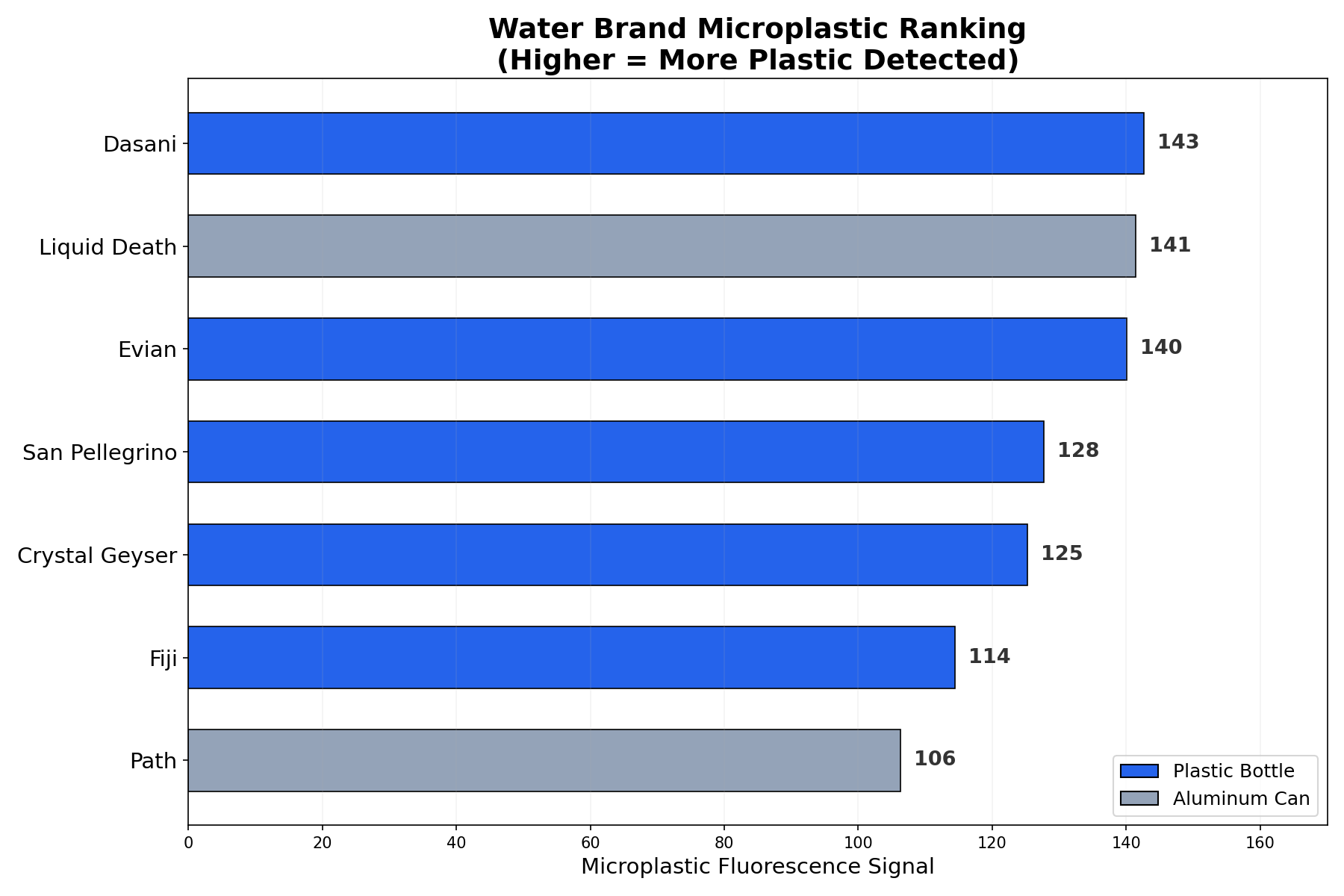
Dasani came in worst at 143. Path came in lowest at 106. But even Path — the "cleanest" brand we tested — still showed a clear PET signal.
There's no winner here. Just degrees of particle load.
And look at this: Liquid Death (aluminum can) scored 141. Dasani (plastic bottle) scored 143. Virtually identical. The can didn't help.
Microplastics in bottled water, brand by brand
Short answer: every brand we tested did. All 7 came back positive for particles consistent with microplastics, and the dominant signature in every one matched PET — the plastic the bottles and can linings are made from. Here's each brand, answered directly.
Does Crystal Geyser have microplastics?
Yes. Crystal Geyser water tested positive for PET particles and landed in the same band as the rest of the brands, between Path (106) and Dasani (143). It's also the brand we ran through both our counting and polymer-ID processes as the worked example below, so you can see exactly how the result was produced.
Does Path water have microplastics?
Yes — but it was the lowest of the seven at 106. Still a clear PET signal, so "cleanest of the batch" is not the same as clean. Path comes in an aluminum can, and like Liquid Death, that lining still read as PET.
Does Dasani have microplastics?
Yes — and it was the worst of the seven, scoring 143 (our highest particle-load reading). Plastic bottle, strong PET signal.
Does Liquid Death have microplastics?
Yes. Despite the aluminum can and the "death to plastic" branding, it scored 141 — effectively tied with Dasani's 143. The can's polymer lining is the most likely source.
Does Fiji water have microplastics?
Yes. Fiji tested positive for PET particles consistent with microplastics, in the same range as the other plastic-bottle brands. We didn't assign it a numeric score this round, so it isn't ranked against Dasani or Path — positive is the finding.
Fiji is the brand people most want to be the exception, because its water starts in an artesian aquifer — about as far from municipal tap as bottled water gets. It still returned the same PET signature as the purified and spring brands, which is the clearest evidence in the study that the container, not the source, is what the stain is finding. The per-brand details are on the Fiji test page.
Does Evian have microplastics?
Yes. Positive for PET, in line with the other plastic-bottle brands.
Does San Pellegrino have microplastics?
Yes. Positive for particles consistent with microplastics despite the glass-bottle premium positioning.
What's the worst bottled water for microplastics — and which has the least?
Of what we tested, Dasani (143) was the worst bottled water for microplastics and Path (106) had the least — but the spread is narrow and there's no clean option here, only degrees of particle load. The container is the common thread, so "least" means lowest particle load, not microplastic-free.
Is there a safest bottled water to drink?
Not one that came back clean. All 7 brands — plastic bottle and aluminum can alike — tested positive for particles consistent with microplastics, with the same PET fluorescence signature in every one. The closest thing to a safest choice among what we tested is Path, which scored lowest at 106, well below Dasani's 143. But lowest isn't the same as safe: the container itself is the likely source, and every brand carried the same signal.
What is the best bottled water without microplastics?
There isn't one — not among the seven we tested, and we haven't found one anywhere else either. Path was lowest at 106, but it still carried a clear PET signal. "Without microplastics" doesn't hold as a literal claim for any bottled brand we've run through the lab; "lowest we've measured" is the honest version of that question, and today that's Path. Nowhere we've found sells bottled water that tests clean — if you're shopping for a brand claiming otherwise, we haven't seen testing that backs it up. The more reliable move is to test what's actually in the bottle yourself.
For the direct comparison — including which brands received numeric readings and which only tested positive — see which bottled water has the least microplastics.
What are the 5 worst bottled waters for microplastics?
We can only rank the brands we gave a numeric score to. Worst to best on that basis: Dasani (143), Liquid Death (141), and Crystal Geyser (somewhere in the 106–143 band). Fiji, Evian, and San Pellegrino all tested positive for the same PET signature, but we didn't assign them a number in this round, so we won't force them into rank order against each other or against Crystal Geyser just to fill out a top 5. Every brand we tested came back positive — the honest answer is a top 2, not a top 5.
Smartwater is the brand people ask about most that wasn't in this batch. Our sister site ran one through the same Nile Red method — a bottle that had been sitting in a car for a year — and the filter came back loaded. The full result, photos included: does smartwater have microplastics.
If you're trying to buy your way out of this, we wrote up the practical version of the question — whether there's a safest bottled water without microplastics, and whether switching brands actually changes what you're drinking.
Or skip the brand list and test bottled water for microplastics at home — the same Nile Red method we ran here, on a 100 mL pour from whatever's in your fridge. It's the only way to know what your bottle is actually shedding.
Update, July 2026: we counted Dasani's particles on camera
Everything above is a signal strength. It answers "what kind of plastic is this consistent with," not "how many pieces are in there." Those are two different processes in our lab and they aren't convertible — the polymer ID runs undiluted Nile Red on a PCTE filter, the counting process runs diluted Nile Red on a nylon filter. One tells you what. The other tells you how many.
So we went back and ran the counting process on Dasani, start to finish, on camera.
One 100 mL pour, one bottle, one lot. The stain indicated 10 particles. One of those 10 was already sitting on the filter membrane before a drop of water touched it — we put the clean filter under the microscope first, which is the step almost nobody films. Subtract it and the honest figure is 9 particles consistent with microplastics in 100 mL of Dasani.
Two things that number is not.
It is not a procedural blank–corrected result. A procedural blank means running clean water through the entire workflow; we didn't do that. Checking the bare membrane removes the filter's own baseline and nothing else.
And it is not the 143 from the table above, converted. Dasani's 143 is a fluorescence reading. Its 9 is a particle count. A brand can be high on one and unremarkable on the other, and reporting them as though they were the same measurement would claim something neither one proves.
Nine is also a floor rather than a ceiling. A person hunting across a membrane under a digital microscope misses particles that software imaging the entire filter area would catch. And it's one bottle on one day — not a per-liter figure for the brand, and not a comparison against the other six.
The full write-up, including why the "1,000 microplastics per bottle" figure that circulates online appears in no study we can find, is on thewatertest.com.
Why the aluminum can doesn't help
This is the finding that surprised us most.
Liquid Death and Path both come in aluminum cans. Their whole brand is built on "not plastic." Premium. Clean. Metal.
But when we ran them through our process, they matched the exact same PET signature as every plastic bottle brand we tested.
Why? Because every aluminum beverage can has a thin polymer lining on the inside. It's there to prevent the metal from reacting with the liquid. Can linings are plastic coatings — typically epoxy- or polyester-based — and in our test, what came out of the cans fluoresced with the same signature as PET.
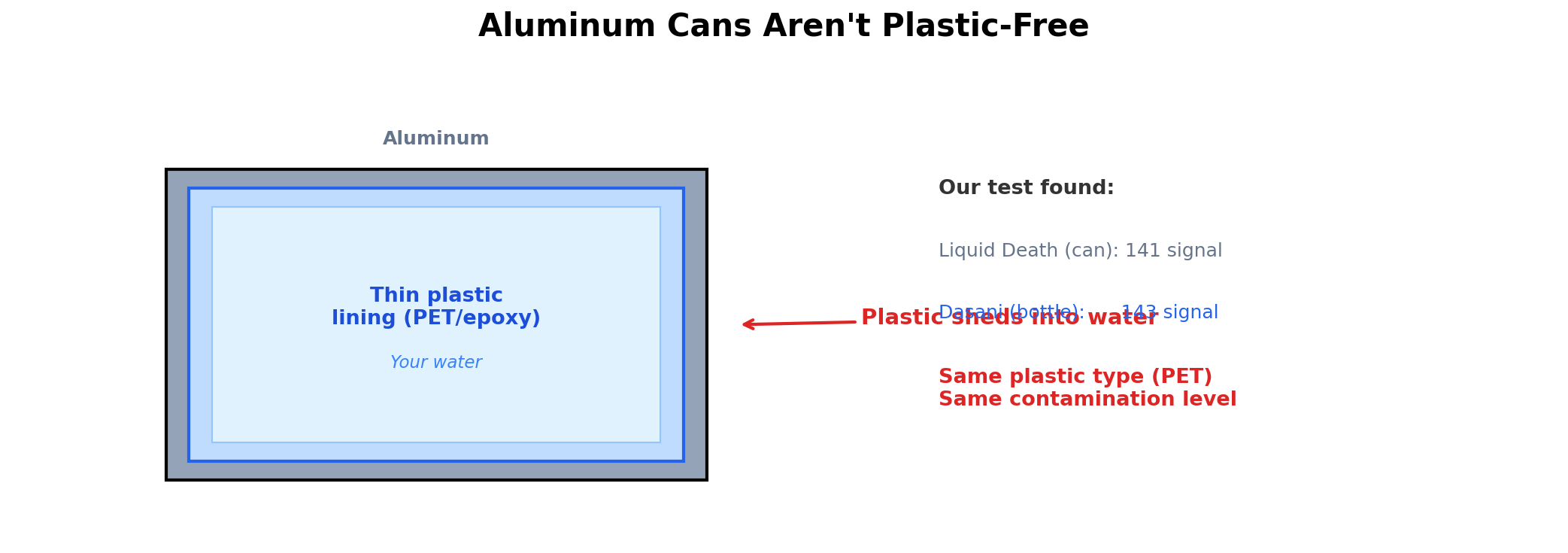
The can looks like metal on the outside. But your water is still sitting against plastic on the inside — and that lining is the most likely source of the PET signal we measured, just like a plastic bottle.
Here's the part that gets us: our classifier identified Liquid Death and Path as PET without being told what container they came from. It just looked at the fluorescence data and said "water bottle plastic." It didn't know about the lining. It just saw the signal.
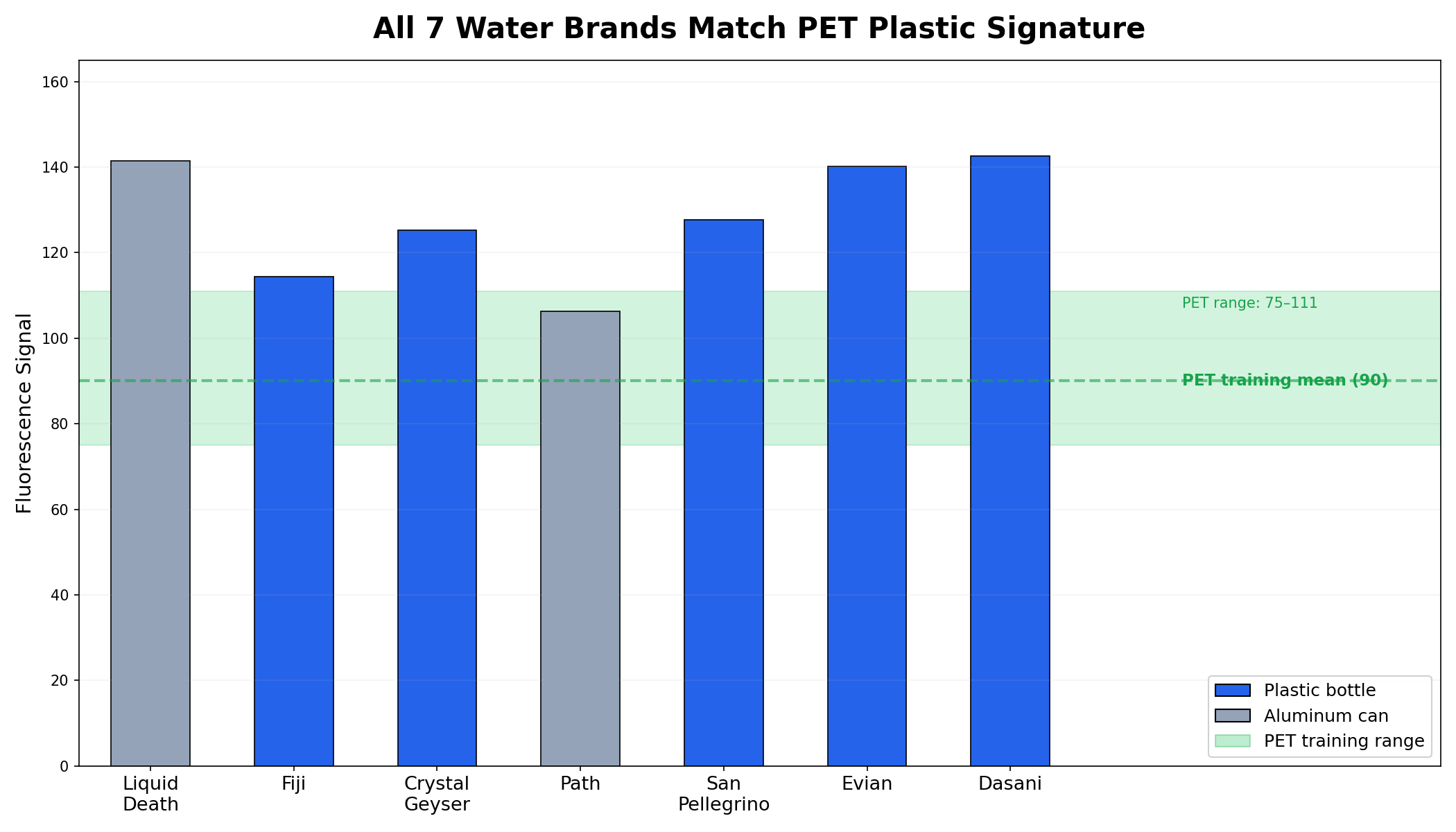
All 7 brands. Same PET fluorescence signature. Whether it came from a $4 aluminum can or a $1 plastic bottle.
How we identified the type of plastic
Until now, identifying what type of plastic was in a water sample required a machine called an FTIR spectrometer. Those cost $50,000 and up. The labs that have them charge $598 to $800 per sample.
We figured out how to approximate it at a fraction of that cost using a fluorescent dye called Nile Red. When you stain plastic particles with Nile Red and shine different wavelengths of light on them, different types of plastic glow in different ways.
Here's the same water sample photographed under three different lights:
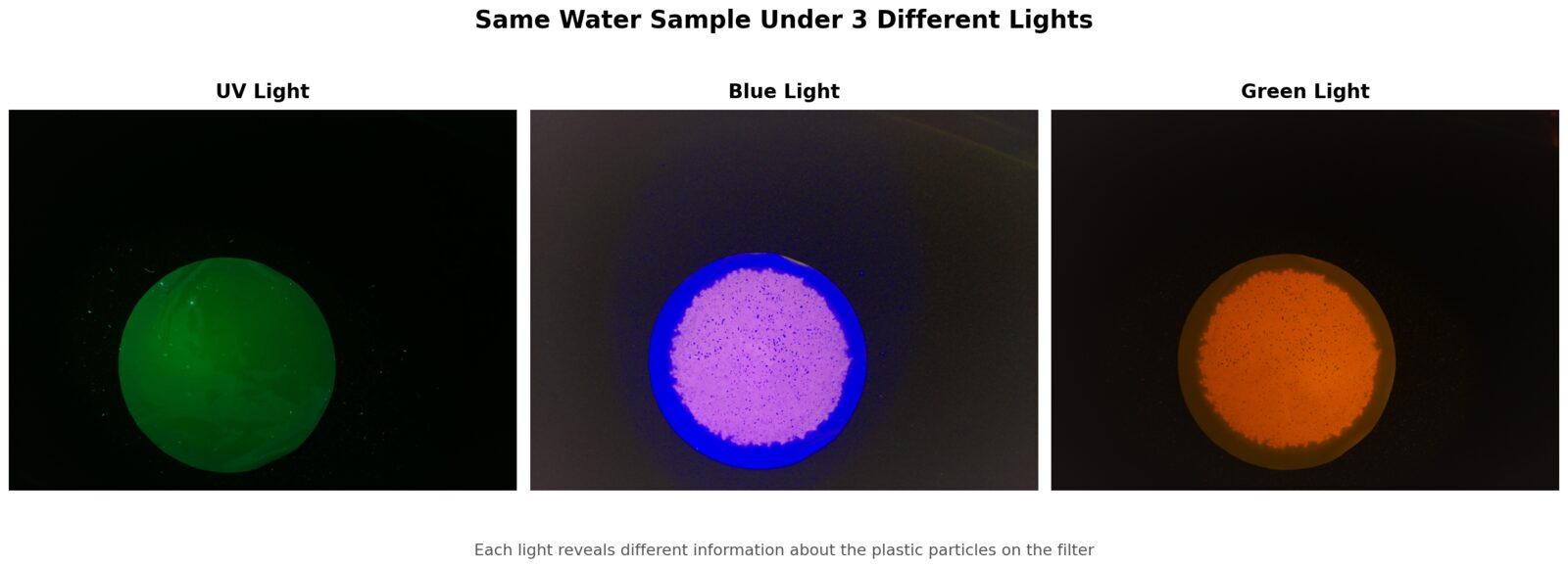
Each wavelength reveals different information about the plastic particles on the filter. By measuring the color intensity across all three channels, we build a unique fingerprint for each plastic type.
Here's what those fingerprints look like:
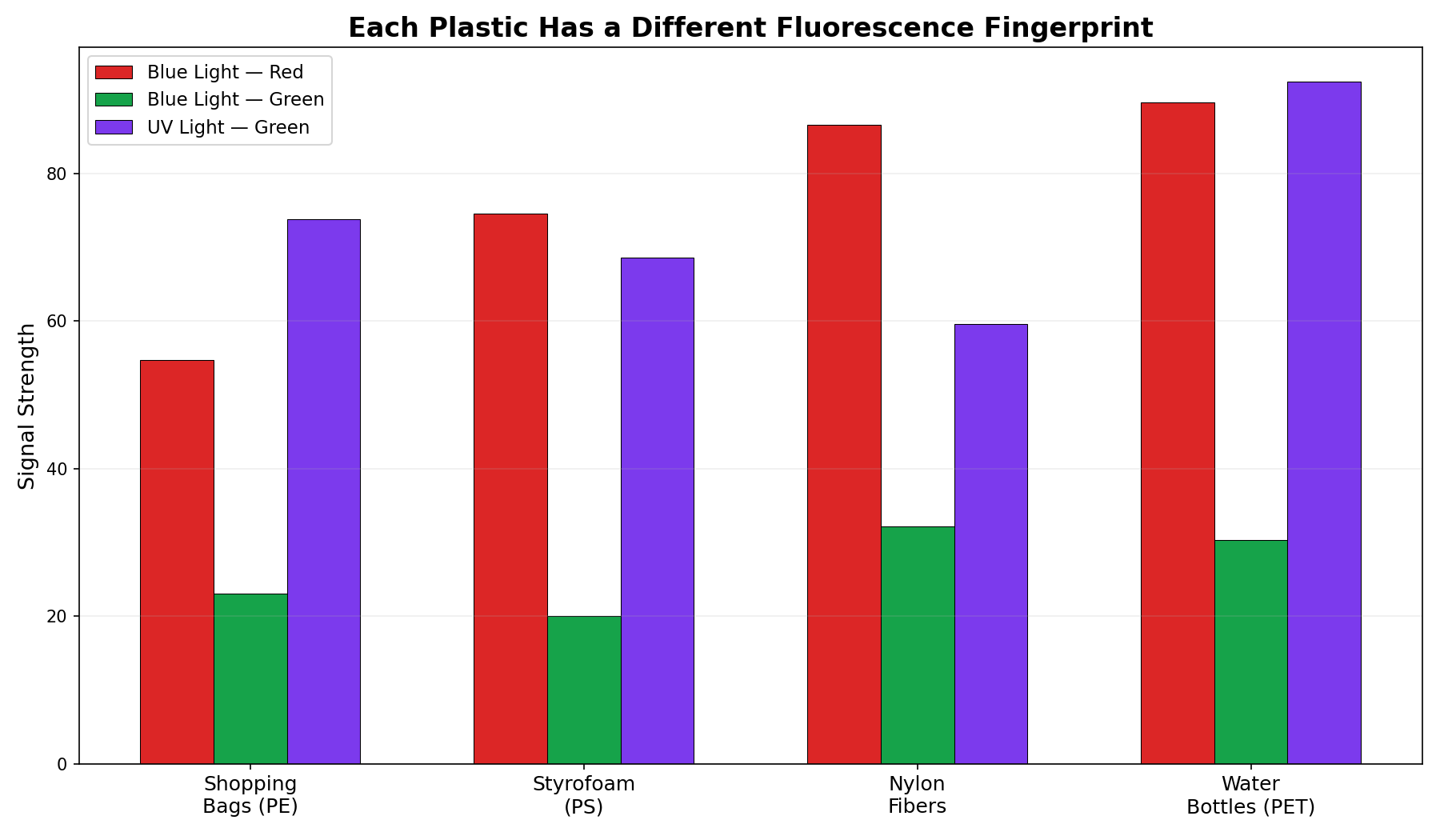
Water bottle plastic (PET) has the strongest UV response. Shopping bag plastic (PE) barely glows under blue light. Nylon fibers have the weakest UV signal. Styrofoam sits in the middle. Each one has a pattern you can't confuse with the others.
Right now our classifier can distinguish 4 types of plastic:
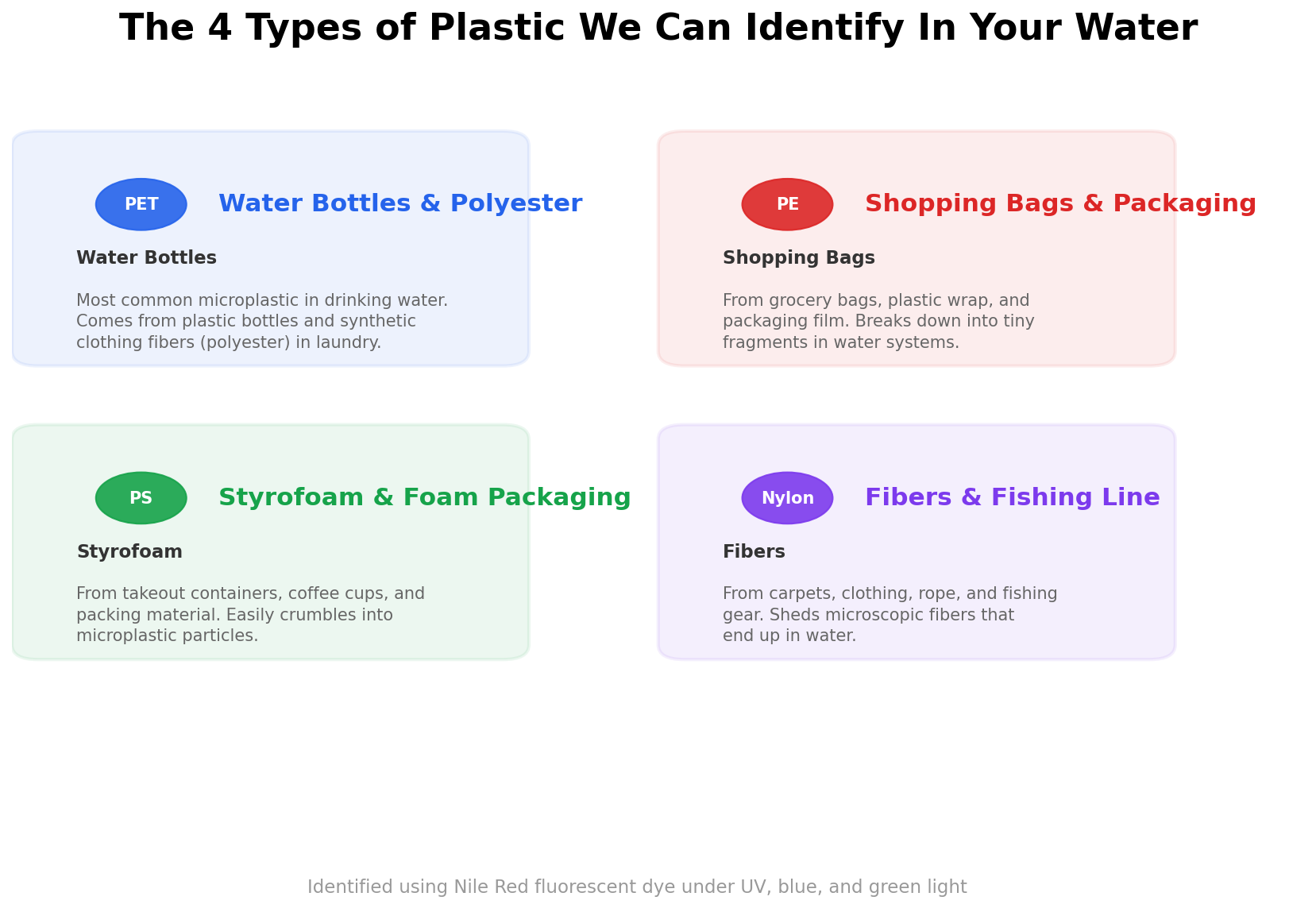
When we tested this classification system on known plastic samples, every single type separated cleanly from every other type. Six out of six possible pairings. Zero overlap.
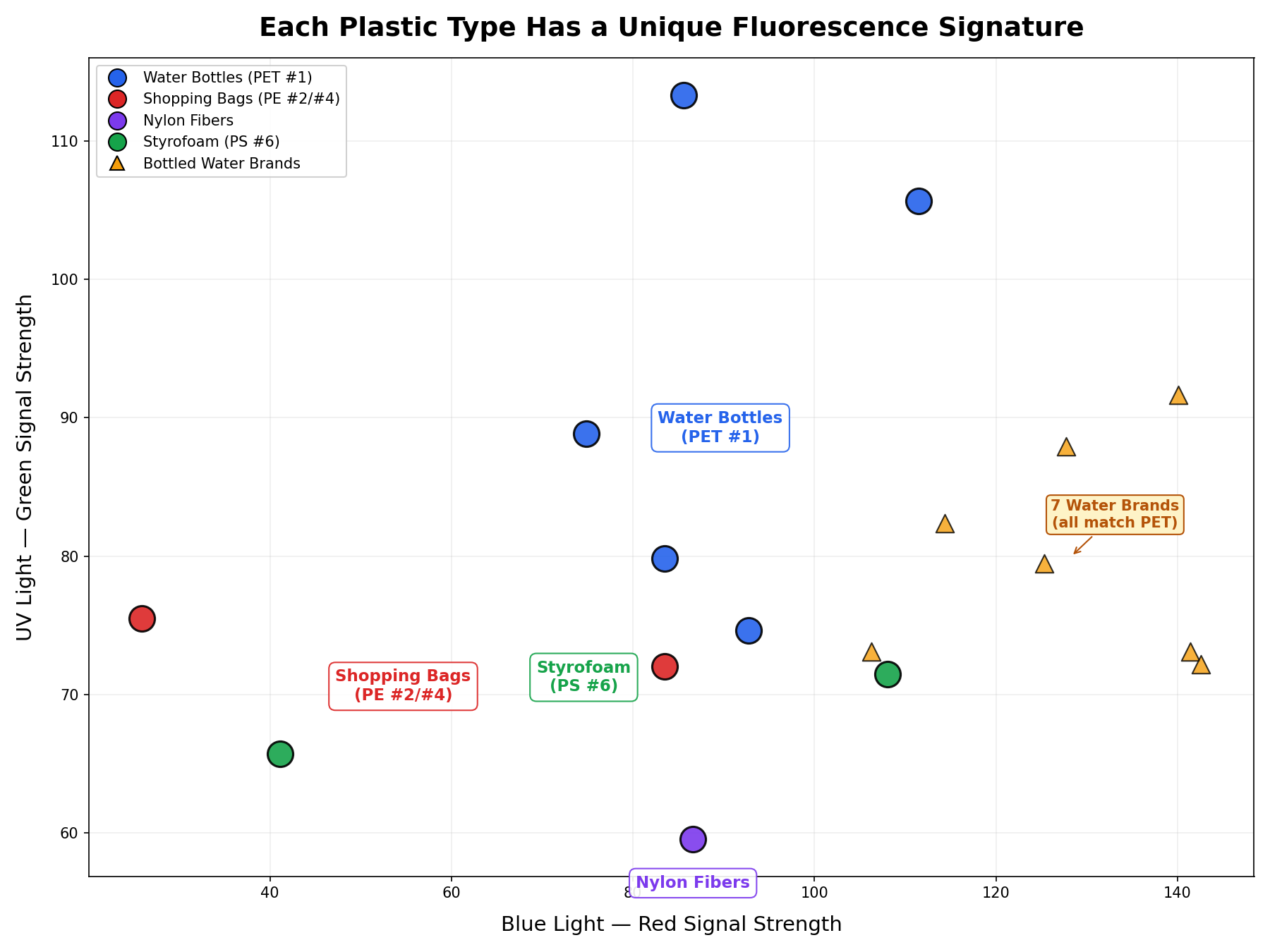
See those orange triangles on the right? Those are the 7 bottled water brands. Every one of them clusters with the PET training samples. Not near polystyrene. Not near nylon. Right on top of water bottle plastic.
This approach isn't new science. Researchers like Meyers et al. (2022) demonstrated polymer identification through fluorescence microscopy with 88% accuracy. The NSW EPA in Australia validated Nile Red methods against traditional FTIR testing. What's new is that we're doing it at a price regular people can actually afford.
We had to build a new process to do this
Our standard process — diluted Nile Red on a nylon filter — is what we use every day to count particles in customer samples. It works. We still use it in production.
But counting particles and identifying what type of plastic they are require different levels of sensitivity. When we tried to run polymer identification with the standard process, the signal was too faint to distinguish between plastic types. Everything looked the same.
So we developed a second process: undiluted Nile Red on a PCTE filter. It's not a replacement — it's a different tool for a different job. The counting process tells you how many particles are in your water. The polymer ID process tells you what kind of plastic they are.
Here's the same Crystal Geyser sample run through both:
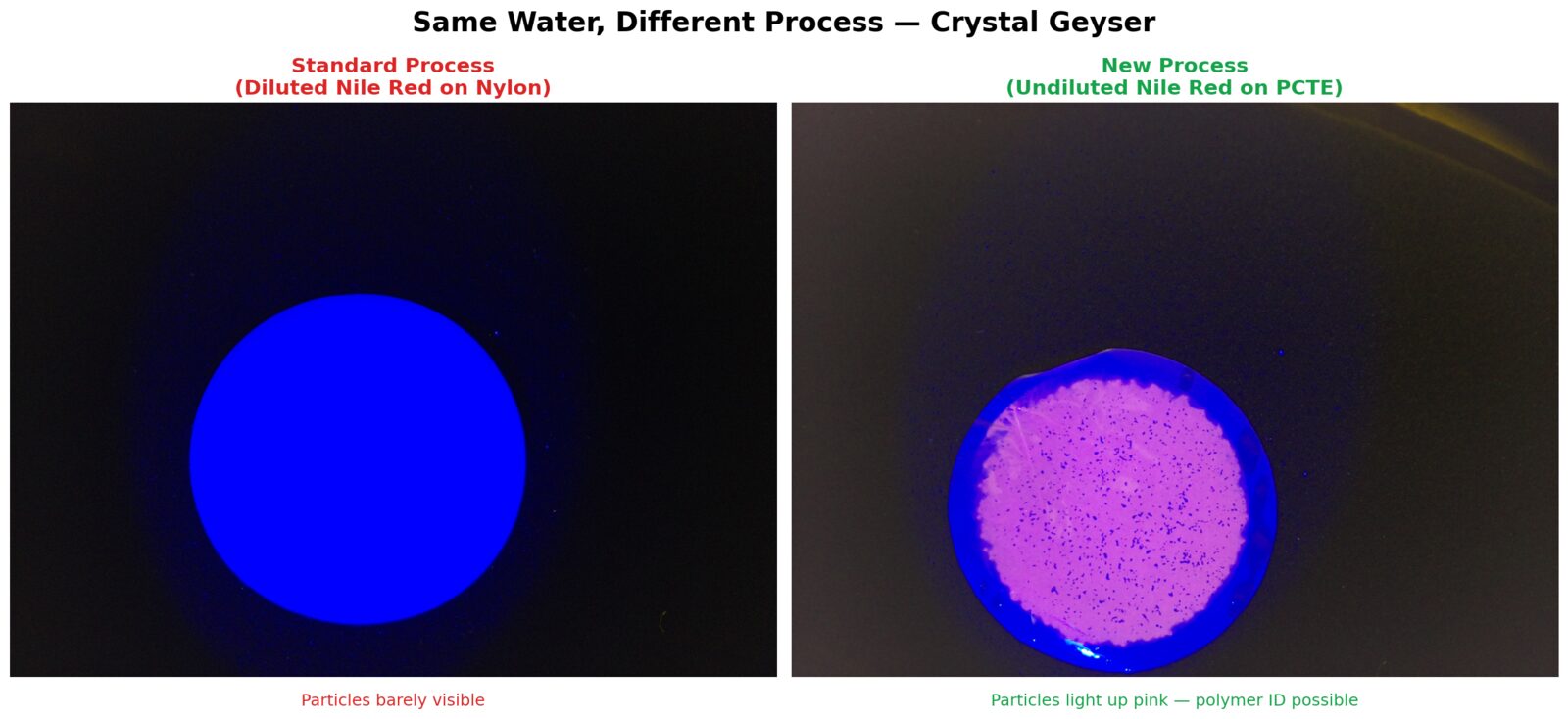
On the left: the standard counting process on a nylon filter. Clean, precise, optimized for particle detection. On the right: the polymer ID process on a PCTE filter with undiluted Nile Red. The stronger staining produces a 1,000x signal boost — enough to measure the fluorescence fingerprint of the plastic and classify it by type.
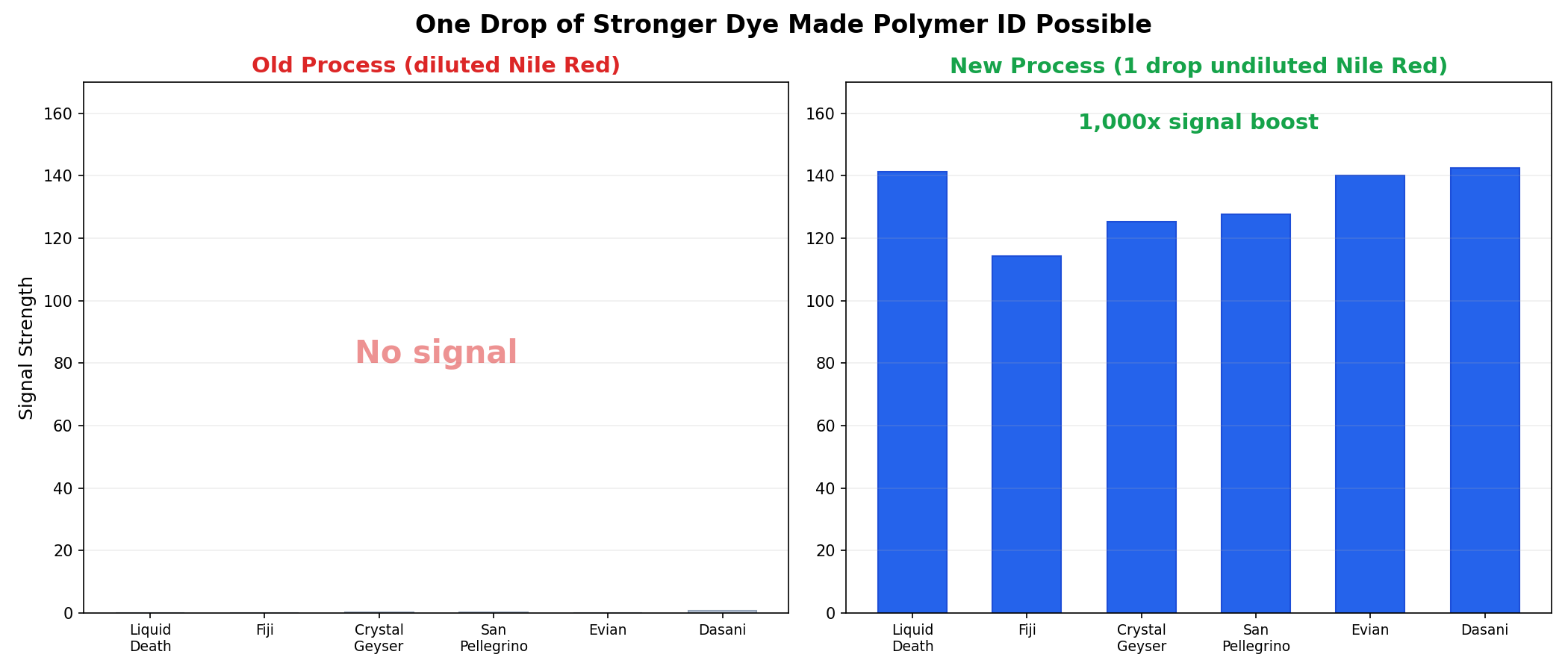
We also had to add a second light source. Under blue light alone, PET and polystyrene look too similar. Adding UV light revealed a 46-point gap between them that was completely invisible before. Different wavelengths reveal different things.
What we can say — and what we can't
What we can say: All 7 brands tested positive for particles consistent with microplastics. The dominant fluorescence signature in every sample matched PET (polyethylene terephthalate) — the same plastic used in water bottles and aluminum can linings. The container is the most likely source of contamination.
What we can't say yet: We can identify the dominant plastic type in a sample, but we can't break it down particle by particle yet. We can say "your water is mostly PET." We can't say "you have 8 PET particles and 3 nylon fibers." That's coming.
These are results from an ongoing study, not a peer-reviewed paper. We're publishing them because transparency matters more than perfection. Our process is adapted from peer-reviewed methods (Meyers et al. 2022; Leonard et al. 2022) — the authors of those papers have not reviewed or validated our kit, and our classifier is still being trained with more samples every week.
One more thing worth being blunt about: Nile Red is a screening method, not chemical confirmation. It stains hydrophobic material generally, so things that aren't plastic can fluoresce too, and definitive polymer ID requires spectroscopy. We keep a complete, plain-English list of every known limitation of this method — false positives, contamination sources, the detection floor, why there's no procedural blank — at thewatertest.com/limitations. Read it before you treat any single number here as gospel.
The bigger number we couldn't measure: nanoplastics
Here's the uncomfortable part. Everything above is a count of microplastics — particles bigger than about 1 micron, large enough to catch on a filter and stain. But microplastics are only the visible fraction.
In 2024, a team at Columbia University used a new laser-imaging technique and found that the average liter of bottled water holds roughly 240,000 plastic particles — 10 to 100 times more than anyone had counted before. About 90% of them were nanoplastics: particles smaller than 1 micron, small enough to slip through the gut wall, enter the bloodstream, and cross the blood-brain barrier. Older methods — including ours — simply can't see them.
So when our counting process flags a brand as high, read it as a floor, not a ceiling. The microplastics we counted are the tip of a much larger iceberg of nanoplastics riding along with them. They come from the same source — the bottle and the can lining — and a brand with more microplastics likely has more nanoplastics riding along too. We can't put a number on the nano fraction at home. Nobody can without a lab. But it's there, and it's the part that reaches the places you'd least want plastic to go.
This is Round 1 of 12
We're retesting the same 7 brands every month for a full year. Same batch, stored in a garage — the way millions of people store backup water for emergencies.
- Round 1 (March 2026): Fresh off the shelf — you're reading it.
- Rounds 2–12 (April 2026 – February 2027): Same batch, retested monthly from garage storage.
The question we're answering: how much particle load does bottled water pick up the longer it sits in the container? If you're storing water for safety or backup, what are you actually drinking by the time you need it?
We'll publish each round's results at thewatermap.com/bottled-water.
What you can do
We're not going to tell you to stop drinking water. And we're not a filter company — we don't sell solutions.
What we do is give you the data so you can make your own decisions.
Some people see their results and realize their tap water with a basic filter is cleaner than the bottled water they've been buying. Some people discover their tap is worse and invest in better filtration. Some people just want to know.
If better filtration is your next move, we've written up what the published evidence shows for the filters people ask us about most: does Brita remove microplastics, does ZeroWater remove microplastics, does PUR remove microplastics, and does Berkey remove microplastics.
If you want to know what's in your water — tap, filtered, or bottled — you can run the same test at home with a microplastics test kit. Two tests per kit, and you stain, filter, and count the plastic particles yourself in about 15 minutes.
All of our data is public. Every test we run goes on the map. You can see results from homes and brands across LA at thewatermap.com.
Want to test your water for microplastics?
Get the at-home microplastics test kit. Two complete tests per kit. See microplastics glow pink under blue light — no lab, no waiting.
Test your water for microplastics →